
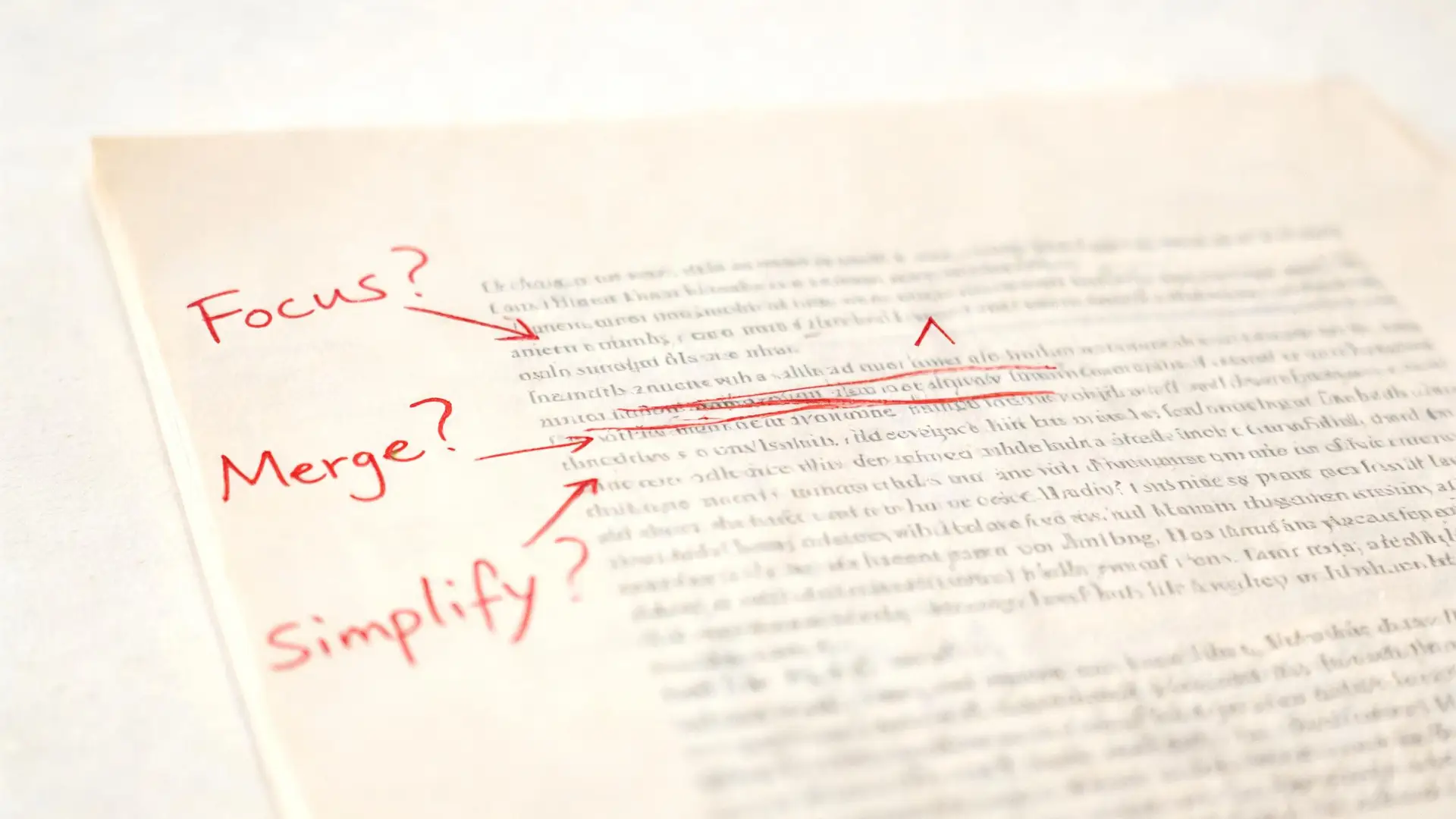
Two rounds of editing on my new story — about the author’s blind spot, why my protagonist knew too much, and what a stranger’s eye sees.
The Stranger’s Eye
Thoughts that move me as I write …
A text doesn’t get better because I stare at it longer. It gets better when someone looks at it from a different perspective and with a different experience. Over the past few weeks, my new story has been through two rounds of editing—one on the structure, one on the individual sentence. Both times I learned the same thing: a text’s weakness lies exactly where I’ve stopped reading it as a stranger’s text.
Now I know this story too well to still see it. I know why my protagonist does what he does. I know what happens before it happens, and I know the price he’ll pay in the end. That knowledge is indispensable while writing—and the biggest blind spot while revising. Because I don’t read what’s on the page. I read what I meant. The gap between the two is exactly where a text fails, and exactly the place I can no longer reach myself.
My protagonist knew too much
The first round of feedback arrived at a density that, honestly, hurt at first: more than a hundred and eighty notes on a single draft. But the longer I read them, the more clearly one finding emerged that lay beneath most of the others. My protagonist thinks too much. He draws conclusions that are too clean. He understands his own situation too early and too completely.
That sounds paradoxical at first. Isn’t a character who reflects deeper than one who merely reacts? While writing, I thought so. My editor showed me the opposite is true: his clarity was borrowed. It was my own authorial knowledge, pushed into his head. A character who, in a situation that overwhelms her, calmly finds the right words for her state doesn’t come across as mature. She comes across as unbelievable.
“Let him doubt instead of reaching for explanations,” one note read. Another: too much reflection and clarity don’t fit what the character is going through. That was the moment I understood that credibility doesn’t come from completeness, but from gaps. What my protagonist doesn’t know, doesn’t name, doesn’t think through to the end makes him more real than any clever line I give him. I had lent him my overview. He needed his own bewilderment.
Explaining is not showing
The second most frequent note was a variation on four words: you can cut this. Almost always it sat where I’d spelled out something I had already shown in the sentence before. A gesture, then its meaning. An image, then its explanation. “The readers will get there on their own,” one note said—and that wasn’t a stylistic tip but a withdrawal of trust I hadn’t noticed in myself.
Because that’s what explaining gives away: that I don’t trust my own scene to work. That I don’t trust readers to understand. Every explaining sentence is a small distrust I write into the text. And distrust costs tension. At several chapter endings I had preempted exactly what should only have gained its force in the next chapter. I had secured the payoff because I was afraid it might not land. The stranger’s eye sees this fear at once. It sees where an author holds on to his own text instead of letting it go.
The second round: the sentence itself
When the second draft came back, the character of the notes had changed completely. No longer a hundred and eighty, but thirty—and they no longer aimed at character and structure, but at the material everything is made of: the single word. Repeated words, marked in color. Verbs that wanted sharpening, because a precise verb makes a scene visible and a pale one lets it blur. Filler words simply struck out—“just,” for example, a word that almost never does anything except make a sentence softer than it needs to be.
That seems fiddly, and it is. But this round taught me the most, because it shows that meaning doesn’t hover above a text—it sits in its words. A story about power can’t be phrased casually anywhere. When the right verb is missing, it isn’t only an image that’s missing; a piece of the experience I want to tell is missing. The rough cut decides whether a story holds. The fine one decides whether you believe it.
What the collaboration really is
For a long time, I thought editing corrected a text. It does that too, but that isn’t the important part. What it really does is give me back the view I lost while writing. It reads what’s there, not what I meant. And that very difference—the one I can no longer bridge on my own—is the real gain.
To hand a text over is to stop defending it. It is to accept that my intention is worth nothing if it doesn’t reach the reader. That is uncomfortable, and it is the precondition for everything getting better.
My story is a different text today than it was two rounds ago. More precise, quieter, less certain in the right places. But I think I’ve become a different author too—one who notices sooner, while writing, when he’s starting to distrust his own story. I feel the reflex even now, as the sentence takes shape. And sometimes, rarely, I leave the gap as it is, because by now I know it’s stronger than anything I could write into it.
How useful was this post?
Click on a star to rate it!
Average rating / 5. Vote count:
No votes so far! Be the first to rate this post.